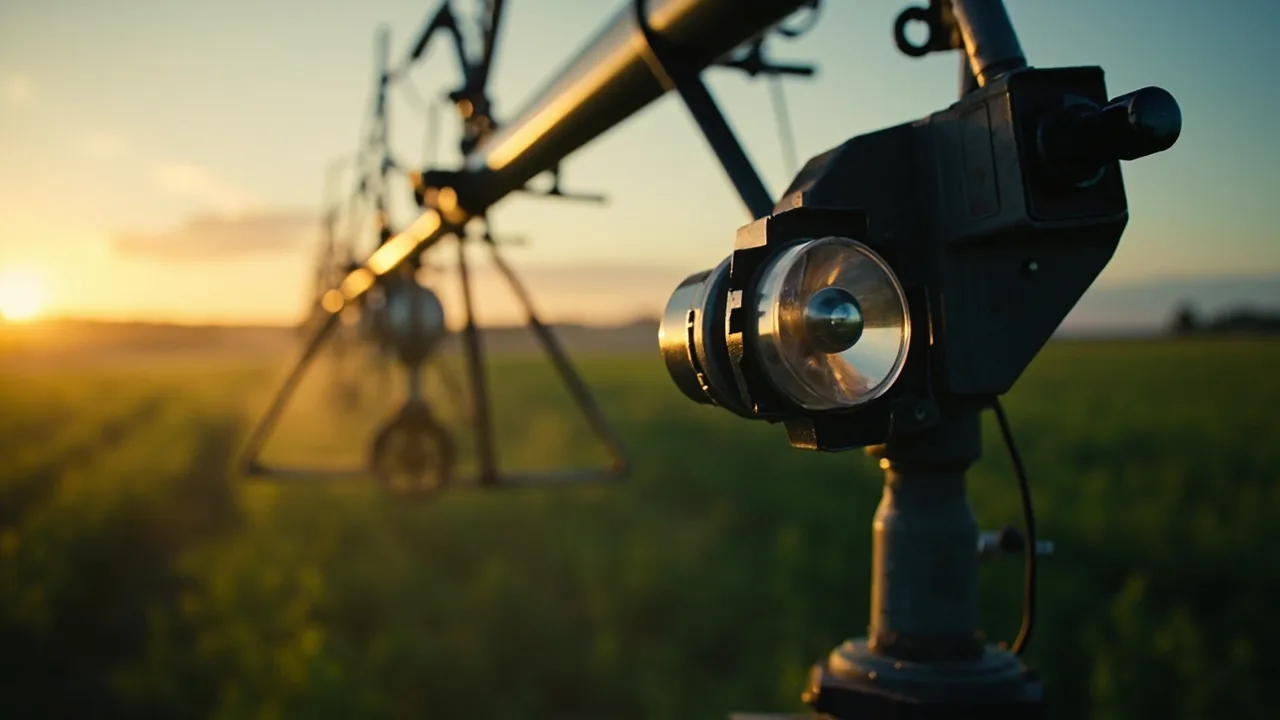

A center-pivot system waters a whole field from one slowly rotating arm, and financing it puts that yield-boosting technology on a Canadian farm without draining the season's cash. These systems are among the most efficient ways to water a large area of cropland, and financing makes one realistic for most operations.
Understanding Center Pivot Irrigation Systems
A center pivot waters in a circle. Sprinkler heads ride a long pipeline that swings around a fixed point in the middle of the field, applying water evenly as it turns. On the Prairies, in Alberta, Saskatchewan, and Manitoba, these machines are the backbone of large-scale farming, keeping wheat, canola, barley, and specialty crops watered on land that would dry out without them.
The design is straightforward: a row of towers carries a pipe that can run hundreds of metres, with sprinklers spaced along it. As the span rotates, every acre under it gets the same treatment, even on uneven ground. Newer systems add GPS guidance, variable-rate watering, and live monitoring that match the flow to the soil and the crop instead of watering everything the same.
A pivot can cost from the tens of thousands into six figures, depending on the field, the length of the span, and the features you add. That price is why financing matters: it lets you modernize your irrigation without draining your cash through the growing season.
Why Finance Your Irrigation Equipment
Financing a pivot instead of buying it outright gives you breathing room. Farm income arrives in a lump at harvest while the bills come all year, so a payment plan that tracks your revenue keeps cash on hand for seed, fertilizer, fuel, and wages.
Keeping that cash lets you react when the weather turns, a market opens up, or a pump fails at the worst moment. Buying the system outright, or selling something to cover it, removes that cushion when you are most likely to need it.
Financing the machine also keeps your bank lines free for operating costs, land work, or a future expansion. A lender who knows agriculture will understand farm cash flow. Farm Credit Canada's guidance on buying or leasing farm equipment notes that “Leasing can be less expensive and simpler than buying since lease payments are often less than loan payments.” (FCC)
Benefits of Financing Center Pivot Irrigation Systems
Preserve Working Capital
Preserving working capital is the main benefit. Farming uses cash all season on inputs, labour, and day-to-day costs. Spreading the cost of the pivot over manageable payments keeps reserves for things that can't wait, such as a surprise repair or an opportunity elsewhere on the farm.
Tax Advantages Under Canadian Regulations
Under the Income Tax Act, a Canadian business can claim capital cost allowance on eligible depreciable property, including farm machinery. With an operating lease, the payments are generally deductible as a business expense, which lowers taxable income. The Canada Revenue Agency's guidance on leasing costs says to “Deduct the lease payments incurred in the year for property used in your business.” (CRA) With a conditional sale or loan, you claim capital cost allowance plus interest instead. Your accountant can show you how to get the most from it within CRA rules.
Flexible Payment Structures
Flexible payment structures follow the farm calendar. Many let you pay less through planting and growing, then more after harvest when the money comes in.
Access to Modern Technology
Irrigation technology keeps improving, with better efficiency, more precise application, and less water used. Financing lets you get the current generation now rather than saving for years. When the next improvement comes, flexible terms make it easier to move to a more efficient system when the numbers work.
Tip for Canadian Farmers
When you compare financing for a pivot, look at the interest rate, the payment schedule, and the options at the end of the term, not just the monthly payment.
Financing Options for Irrigation Equipment
The main ways to pay for a pivot are an equipment lease, equipment financing, and an operating lease. Knowing the difference helps you pick the one that fits your books.
Equipment Lease
An equipment lease gives you the right to use the system for a set term in exchange for regular payments. When it ends, you can usually buy the machine at fair market value, return it, or upgrade to newer technology. Leases often stay off the balance sheet as liabilities, which suits some reporting needs.
Equipment Financing
Equipment financing, through a loan or conditional sale, puts the system fully in your name once the last payment clears. The lender holds a security interest until then. You build equity in the asset along the way, and the capital cost allowance treatment noted above helps at tax time.
Operating Lease
An operating lease treats the pivot as an expense rather than an asset you own. Payments are typically fully deductible, and there is no ownership obligation at the end. It appeals to operations that want to keep the balance sheet light and avoid a long-term commitment.
Cost Considerations for Center Pivot Irrigation
The cost of a pivot depends on field size, span length, your water source, the terrain, and how much technology you add. A basic setup for a smaller field might land in the thirty-to-fifty-thousand-dollar range, while a GPS-driven, variable-rate system for a big prairie quarter can go past a hundred and fifty thousand.
Beyond the machine itself, budget for installation, site prep, the electrical hookup, water-supply work, and any permits your province requires. Add-ons like end guns for the corners, soil-moisture sensors, and remote monitoring raise the total, but they often pay back quickly through better water use and less time spent checking on the system.
When you compare financing, look past the headline rate to the annual percentage rate, which includes every charge. Your rate depends on your credit, the amount, the term, and whether you choose fixed or variable.
Financing Center Pivot Irrigation Across Canada
Irrigation needs differ by province. In southern Alberta, irrigated agriculture is a pillar, backed by long-standing infrastructure. Saskatchewan keeps investing to expand irrigation where the land suits it. Manitoba's industry serves a mix of crops across varied soils.
Equipment Leasing Canada finances equipment in every province and territory. The application considers what matters on a farm: seasonal revenue, your region's growing conditions, and the crops you grow.
How to Apply for Irrigation Equipment Financing
Applying for irrigation equipment financing starts with a clear look at what you need, followed by a short application: basic business details, the specifics of the system, and enough financials to show you can carry the payments.
The Equipment Leasing Canada application usually needs little paperwork, and qualified applicants often get a fast approval, so you can act before a deal or the season slips away.
Once you are approved, the arrangement is documented and your vendor is paid directly. Payments start on a schedule you choose, usually lined up with your cash flow.
Ready to finance your pivot? Apply for equipment financing or estimate your monthly payment.
Frequently Asked Questions
What credit score is needed to finance center pivot irrigation equipment in Canada?
There is no single number. Equipment financing looks beyond the score to the farm's overall health, your revenue history, what you already owe, and the value of the system itself. Equipment Leasing Canada works with farms in a range of credit situations.
How long can I finance an irrigation system in Canada?
Usually three to seven years, sometimes longer depending on the machine's age and the amount. A shorter term means bigger payments but less interest overall; a longer one lowers the monthly payment but costs more over the term. The right length balances your cash flow against the total cost.
Can I finance used or pre-owned center pivot irrigation systems?
Yes. Many arrangements cover pre-owned equipment, with terms based on the system's age, condition, and remaining life. Financing a used pivot can be a cost-effective way to get the technology for less than new.
What happens if my irrigation equipment needs repairs during the financing term?
You generally pay for upkeep and repairs, as the owner or lessee. Servicing the system on the manufacturer's schedule protects its performance and your investment, and supports resale value if you plan to trade up later. Some deals include a maintenance or service package from the dealer.
Are there government programs that help Canadian farmers finance irrigation equipment?
Yes. Several provincial and federal programs support irrigation, including the Canadian Agricultural Partnership streams in various provinces, with grants, low-interest loans, or technical help for eligible projects. Equipment Leasing Canada doesn't run those programs, but financing can be arranged to complement any public funding you receive.
For background, there are separate guides to equipment leasing and equipment financing for Canadian businesses.
Share this article
Need Equipment?
Get approved for equipment financing in as little as 24 hours. No obligation application.
Get a Free QuoteOr call us directly
1-833-924-9554